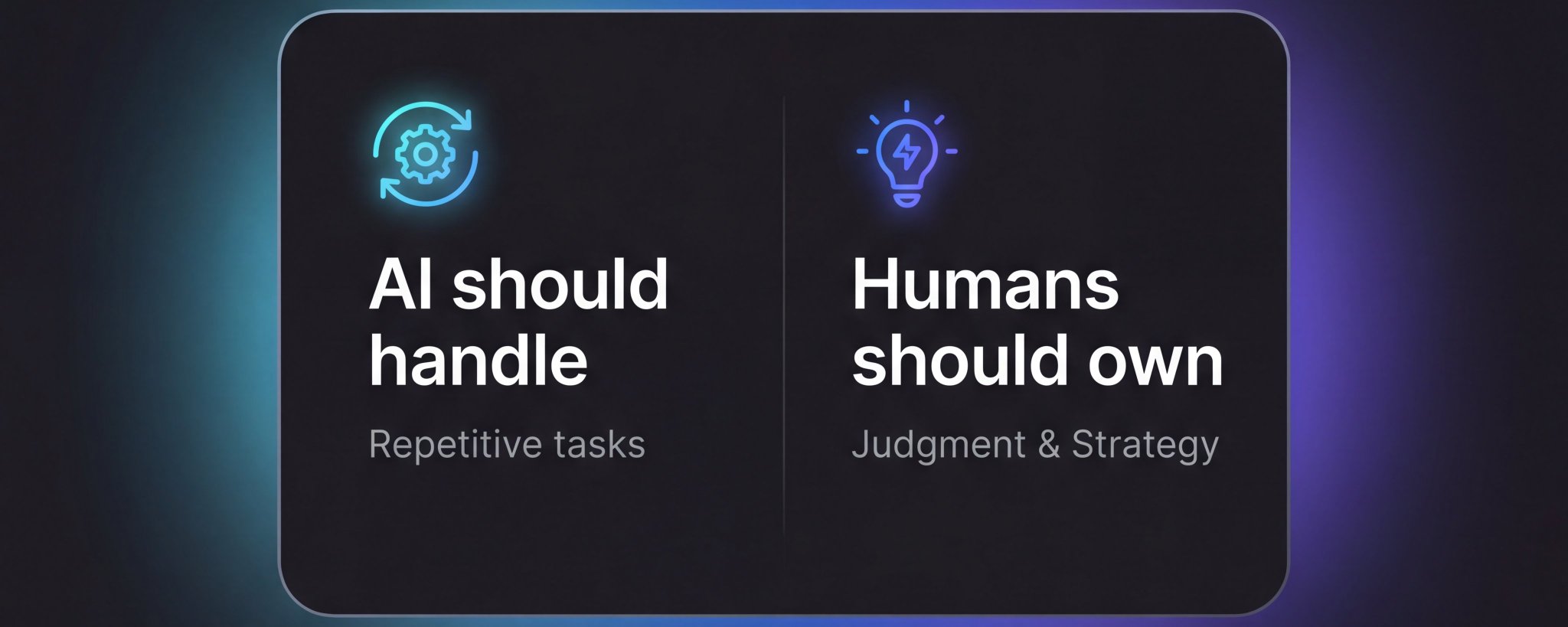
AI should not be a replacement for your marketing team.
It should be the part of the workflow that quietly disappears.
That is the real promise. Not magic, and not a machine that suddenly knows your brand better than the people who built it. Just a system that takes repetitive execution work off your plate so your team can spend more time on creativity, strategy, and decisions.
The question most teams ask is the wrong one
The conversation around AI content is still stuck on whether AI is "good enough" to write brand content, as if the goal were to replace the thinking behind it. Good marketing does not work that way. It needs judgment, positioning, and a point of view. It needs someone who notices when something sounds polished but empty, or efficient but off-brand.
Those are human decisions. AI is useful for everything around them.
The better question is not "Can AI write this?" It is "Which part of this work actually needs a person?" The answer is usually smaller than teams expect, and more important.
What AI should handle
AI should take the work that is repetitive, time-consuming, and structurally predictable:
- Drafting first-pass copy from an approved brief.
- Repurposing one idea across several channels.
- Summarizing source material.
- Formatting, resizing, or reworking a post for another platform's layout.
A lot of the time spent "doing content" is this kind of work: turning one idea into six outputs, one asset into the formats each channel needs, or rough notes into something shareable. The logic repeats even when the final output still needs care, which is exactly where AI helps.
What humans should own
People should own the work that depends on taste, context, and accountability:
- Deciding what the message should be in the first place.
- Deciding how the brand should look, feel, and sound.
- Deciding what not to say.
- Deciding whether something is worth publishing at all.
- Deciding whether a campaign fits the moment.
The split at a glance
| Part of the work | AI handles | Humans own |
|---|---|---|
| Brand | Applying the voice and rules consistently | Defining the voice, positioning, and limits |
| Message | Shaping drafts around the chosen message | Choosing the message and what to leave out |
| Channels | Adapting format, length, and layout per channel | Choosing which channels the idea deserves |
| Quality | Flagging drift, gaps, and unsupported claims | Deciding what "good" looks like and approving it |
| Publishing | Preparing posts and schedules | Deciding whether and when it goes live |
Why the wrong split creates more work
Teams that hand over too much of the thinking get content that is fast but generic. They then spend more time editing the output than they would have spent writing it properly.
That is not an AI failure. It is a workflow failure.
If you expect AI to infer your brand voice, positioning, audience nuance, and risk tolerance from scratch, you are asking it to do a human job without human context. The output drifts. Important distinctions get flattened. The result is technically fine and emotionally hollow.
When teams know exactly what AI is responsible for, they stop trying to force it into the wrong role. When they know what people are responsible for, they protect the parts of the process that make the brand distinct.
Why lean teams feel this most
Lean teams have no one to absorb the overhead, so every extra step costs more. They do not need to work harder. They need fewer obstacles between a decision and a finished piece of work.
That is where a good AI system creates value: not by replacing the human layer, but by reducing the friction around it.
Why brand context matters
Generic tools can help you produce content faster, but they rarely help you produce content that still sounds like you. They do not know your tone, your boundaries, which phrases are too generic for your brand, which ideas you want to lean into, or how your voice should shift across channels without losing consistency.
A useful AI system should feel like an assistant that has already been briefed, not a stranger you have to explain everything to. It should know enough about the brand to stay inside the lines, without pretending to replace the people who draw them.
That is the model Daoco is built on: brand context kept in one place, execution work handled by AI, and decisions and approval left with your team.
The short version
- Humans define the brand. AI learns it.
- Humans choose the message. AI helps shape the draft.
- Humans decide what good looks like. AI helps get the work there faster.
The pressure to publish is higher, there are more channels, and audiences have less patience for inconsistency. The answer is not humans or AI. It is people deciding what matters, and AI handling the work around it.